Parker Reed · 21 September 2026
Poland Integrates Artificial Intelligence into Green Skills Education Across Warsaw and Krakow Universities
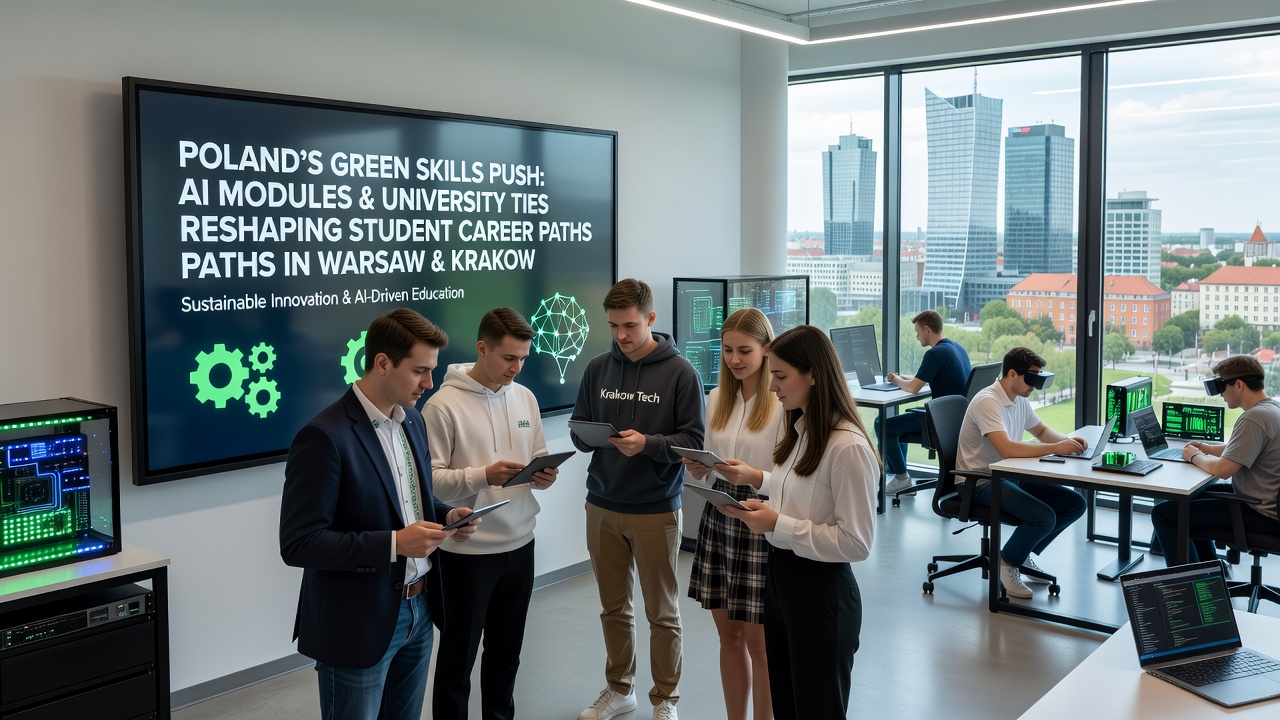
Poland continues to expand its focus on green skills development through partnerships between universities and technology programs, with particular emphasis on artificial intelligence modules offered in Warsaw and Krakow. These initiatives connect higher education institutions with industry requirements for sustainable practices, and they incorporate AI tools that support environmental monitoring, renewable energy management, and climate data analysis. Data from the Polish Ministry of Education and Science shows enrollment in related programs rose steadily between 2023 and 2025, while projections indicate further growth beginning in September 2026 when additional AI-enhanced courses launch at multiple sites.
University Partnerships Driving Curriculum Changes
Warsaw universities have formed direct links with technology firms and government agencies to embed AI modules into environmental science and engineering degrees, allowing students to work with real-time datasets on air quality, urban planning, and resource efficiency. Researchers at the University of Warsaw documented how these modules use machine learning algorithms to simulate carbon reduction scenarios, adn they noted that students complete capstone projects tied to local municipal sustainability goals. Krakow institutions follow a similar pattern, yet they place greater weight on interdisciplinary tracks that combine AI with biology and economics, creating pathways that prepare graduates for roles in both private sector green technology companies and public environmental agencies.
Evidence from the European Commission indicates that Poland allocated part of its recovery funds toward digital and green transitions in higher education, which supports these university collaborations. Observers note that the approach differs from earlier vocational training models because it emphasizes computational skills alongside traditional environmental knowledge, and this combination appears in course descriptions published by both cities' leading schools.
Career Path Shifts Observed in Both Cities
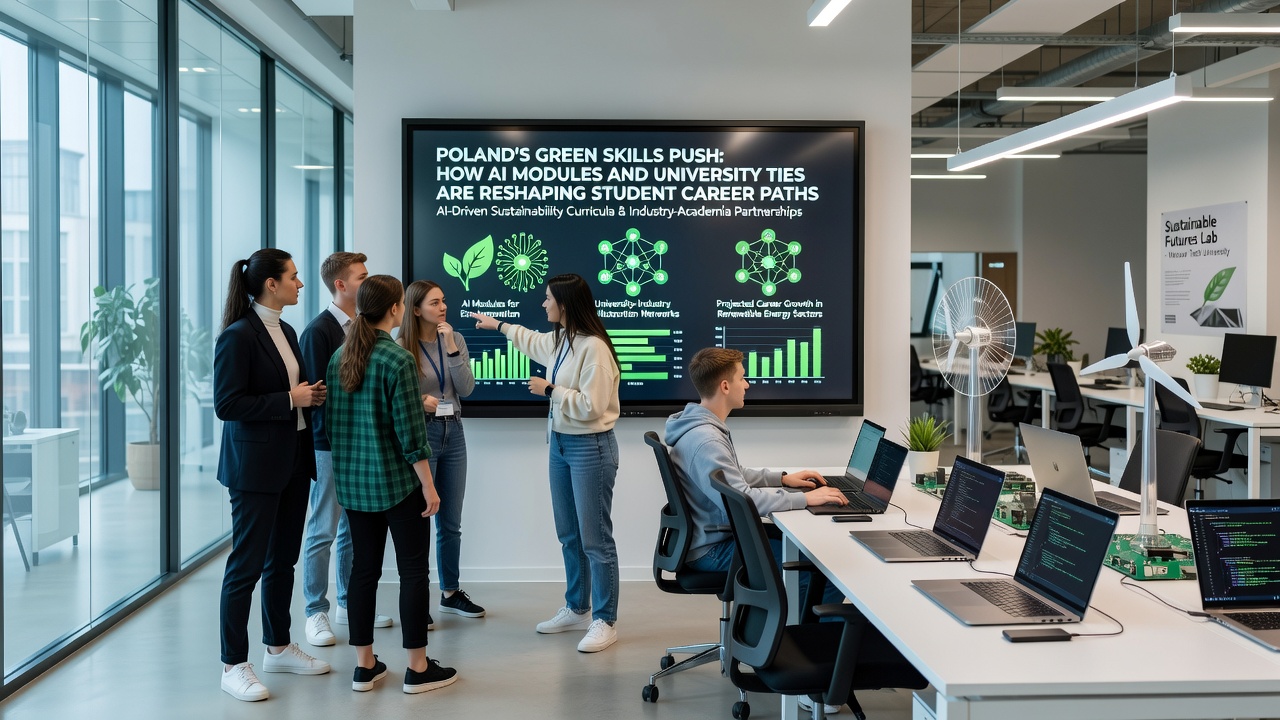
Graduates from these programs enter fields that require proficiency in AI applications for sustainability, including positions at energy firms, consulting groups, and research centers focused on climate adaptation. Figures released by Poland's Central Statistical Office reveal an increase in job postings that list both green credentials and data analytics experience, particularly in the Mazowieckie and Malopolskie regions that encompass Warsaw and Krakow. Students who complete the AI modules often secure internships with organizations working on EU-funded projects, and these placements frequently convert into full-time roles after graduation.
One study conducted at Jagiellonian University tracked alumni outcomes and found that participants in the green skills tracks reported higher placement rates in technical positions compared with peers in standard environmental programs. The research highlights how AI training enables graduates to contribute to projects involving predictive modeling for renewable energy output or automated waste management systems, skills that align with national targets for reducing emissions by 2030.
September 2026 Expansions and Broader Context
Beginning in September 2026, several Warsaw and Krakow universities plan to introduce updated AI modules that incorporate advanced natural language processing for environmental policy analysis and computer vision for biodiversity monitoring. These additions build on existing frameworks and respond to feedback from industry partners who identified gaps in graduate preparedness for large-scale data interpretation. According to reports from the European Commission, such curriculum updates across member states help meet workforce demands created by the European Green Deal, and Poland's implementation reflects this coordinated effort.
Additional data from the OECD shows that countries investing in combined digital and sustainability education see measurable gains in graduate employability within five years, and Polish institutions track similar metrics through annual surveys. The programs in Warsaw and Krakow therefore represent part of a wider pattern rather than isolated experiments, with administrators coordinating across institutions to standardize certain AI competencies while preserving local specializations.
Conclusion
Poland's universities in Warsaw and Krakow continue to adjust degree offerings around AI integration and green skills, producing graduates equipped for evolving labor market needs. Government statistics, university reports, and international frameworks document steady progress in these areas, with new modules scheduled for September 2026. The partnerships established between academic institutions and external organizations supply the practical components that link classroom learning to professional applications in sustainable development.